
Multi-Age Homeschool Curriculum Choices for Preschool, 2nd, and 3rd Grade

Today I'm sharing our curriculum choices. Hopefully it will be helpful to some of you who have children the same age as mine!
I wanted to be able to combine the kids' schooling as much as I could. I enjoy the “one room schoolhouse” style, but I do find it works better with certain curriculum than others.
I picked most of these in the spring, and we started using them in the summer so that I could make sure before the school year if it would work.
Here's what we chose:
Bible
Last year we used a video curriculum for all of our subjects, but the kids' favorite was by far their Bible class. I enjoyed having their Bible class on video as well because it gave me an opportunity to straighten the house, put in a load of laundry, get the baby dressed, etc. I didn't have to be around because I knew the kids were enjoying their class enough that they stayed tuned in and didn't get into any mischief!
This year we will be using BJU Bible Truths Online Learning. I loved the fact that they offer their Bible class as a stand-alone option since that was all I wanted to use as far as video courses. I know that their materials will be in line with what we believe Biblically, and the classes look like they'll be really interactive and enjoyable!
All kids will do Bible simultaneously.
Math
For math, we are using Khan Academy for my 3rd grader and miscellaneous worksheets for my 1st/2nd grader.
We've already been using Khan Academy, and it's been working very well for us! My son is motivated to do his math because he can see the points he is racking up every time he answers a question correctly. It also helps him focus because he only sees one question at a time and he doesn't get overwhelmed with looking at a whole paper that he has to complete. Most days he asks if he can keep going on math because he doesn't want to stop yet! That is a MAJOR change from last year! (Oh, and did I mention Khan Academy is FREE?!)
We also have the app on our iPad so they can use it on there if someone else is using the computer.
I am having my daughter work through 2nd grade worksheets that she didn't finish last year (I bought her a set last year when her brother was in 2nd grade because she liked to listen in to his classes. She couldn't quite keep up with all the paperwork, though, so we are going through and finishing those and reviewing all of that.)
I am also having both of them do XtraMath every day for drilling their math facts. I am very happy with this program too. It's saving me lots of time drilling them myself, and it's actually doing a better job! The program is intuitive – it can tell which facts need the most work, and it will make those problems show up more often until the student starts answering them quickly enough on a consistent basis. The kids enjoy this program too, and it's good motivation for them to try their best.
The 2 older children work on math simultaneously – each on separate devices – while I work with my preschooler. (I do not use a formal curriculum for preschool.)
Language/Spelling/Writing
For language, I am working with both kids together. We are using Primary Language Lessons. I have it downloaded on my phone in Google Play, so it always opens up to the last page I was on.
I really wanted to cut down on the amount of paperwork the kids had to do this year because it was really discouraging them (and me too!) I started digging around to find something that would combine language, spelling, and writing so that it was all being practiced simultaneously, cutting down on time and busywork.
When I found Primary Language Lessons, I knew it would be perfect. We have been using that through the summer just to make sure it would work for us, and it is working beautifully. (And you can't beat free!)
Basically I just open it up and teach the lesson (only takes about 5 minutes), then they have to write sentences about the lesson. Sometimes they are making up the sentences themselves, while practicing proper grammar and punctuation; sometimes they are filling in blanks with things like they're, their, there or is, are.
They have to use their neatest penmanship, and I make them practice any particular letters with which they are struggling.
I also check for misspelled words and add those to a list, which becomes their spelling list for the week. They then copy their spelling list daily, and we practice spelling the words aloud together also.
I love how the process is so streamlined. The kids are not feeling overwhelmed, which means they actually work faster.
I'm not sure if I would feel comfortable doing language this way if they did not have a very strong foundation from Kindergarten through 2nd grade, though. We used A Beka curriculum for those grades, which has a very strong emphasis on phonics, and we have drilled and drilled the special sounds for 3 years. When we are practicing spelling, we are reviewing the special sounds and why those words are spelled that way.
The two older children do language/spelling/writing simultaneously. I work on letters and sounds with my preschooler at a separate time.
Reading
I had a “duh” moment.
My kids read every spare moment! On their bed, in a tree, walking down the road (had to put a stop to that one!)…
Why should I make them sit down and read and prolong their school day?! I just let them read whatever and whenever they want, and we don't use a reading curriculum.
I do like for them to read out loud to me while I'm cooking supper. That way I can ask them comprehension and vocabulary questions just to be sure they're getting all they can out of their reading.
If my kids weren't good readers, I may have to consider a formal reading curriculum, but at the same time, I'm not so sure if that would be the case. I sort of feel like taking this approach all along is part of what has made them love reading — it's always been something they get to do, for fun!
Reading happens organically throughout the day. There is not a set time for this.
History
I really wanted to use a history curriculum that lines up Biblical history with world history so the kids (and myself!) could see where world events fit into the Bible as well get more insight into the cultures of Biblical times. I ended up going with Diana Waring's Ancient Civilizations and the Bible. It is really geared a little more for older students, but the beauty of this curriculum is that it is purposely designed for the student to explore his interests and to learn using the style that suits him best.
I've set aside 15 minutes of our school day simply to decide what we're going to do for history. The book offers lots of suggestions for learning resources for the current topic (crafts, books, videos, etc.) so the kids and I decide together what will fun and feasible.
Once we've decided what we explore and what we'll do, we simply incorporate that into our day instead of making it a part of school. There is some book learning to do as well as supplementary books that I read aloud, but there is also time to do lots of hands-on activities like making an Egyptian costume, cooking an ancient Egyptian recipe, or building pyramids in the sand!
There are also supplementary CDs that we listen to while I'm cooking supper. The kids play with blocks at the table to keep their hands occupied while they listen.
All children do history together.
Science
We are using schoolhouse teachers for science.
All 3 children do science simultaneously.
Art
We will be using Baby Lamb's Book of Art. It's for ages 3-5, but I don't think the older ones will care, and I needed something that they can all do together, including the 4 year old.
All children do art simultaneously.
Greek
Yes. Yes I do plan to teach my children Biblical Greek. I want them to know how to study God's Word in depth, and I think it will be better to get them started while their minds are young and sharp. We'll be using Hey Andrew, Teach Me Some Greek! Level 1.
All children do Greek simultaneously, although the youngest will just be listening in and picking up whatever he can at this point.
Typing
I would like to get the kids typing a couple times a week. Does anyone know of a good program? This is the one thing I haven' figured out yet!

17 Ways To Ensure Your Son Will Not Be a Gentleman
“How are you?” she asked, but there was no response, other than the grumpy look on his face.
“Surely he answered and I just didn't hear him,” I thought to myself in surprise. But as she asked another question and then another, even she began to look surprised.
I could not believe she just spoke directly to his face and he just stared back at her with a scowl!
This was not a troubled teen. This was a young adult from a good home who should have known better.
About a week later, I happened to pass him and when I said hello he continued on without even acknowledging that I had spoken. I was flabbergasted.
Then I remembered a college professor of mine who said that this happened to him all the time with college students. He would say good morning and they just simply wouldn't answer. (He would just run back around in front of them and try it again until he got an answer!)
But again, these weren't young adults from troubled homes. For the most part these were people from good families, but they all had one thing in common: they were RUDE!
If such a large number of young adults have grown up not having learned basic manners, I have to wonder if parents are dropping the ball. I understand that ultimately children make their own choices, but when it comes to something like manners, those aren't really choices; they're habits that are learned from the earliest ages.
The following are ways that parents unintentionally raise sons who are not gentlemen. (And if you have daughters, any of the points that are not boy-specific absolutely apply.)
Let's work hard to avoid these parenting pitfalls and teach our children to be polite, caring adults!

1. Let him play rough with his sisters or female friends.
This will help him learn that ladies are not to be treated gently and with respect.
2. Don't let him help carry groceries for mom.
Mom can do it faster herself, and not allowing him the privilege to help will teach him that ladies don't need gentlemen to help them anyway.
3. Don't make him give his seat to a lady.
This will teach him to take care of himself when he's tired (or lazy.)
4. Don't enforce table manners.
This will help him understand that he is too dumb to use them anyway and that “real men” are crass.
5. Don't make him speak when someone speaks to him.
This will help him understand that his own feelings are more important than treating other people with respect. (Note: I understand that some young children are extremely shy. But if you always use that as an excuse, they will have a very hard time overcoming it when they're grown. This post has a suggestion for gently helping children who struggle with being shy.)
6. Always let him choose the activity when friends are over.
This will teach him not to value the opinions and wishes of others, especially when they are different from his own.
7. Don't make him apologize when he bumps into someone or knocks something over.
This will teach him to live recklessly and without thought of how his actions affect others.
8. Allow him to cut in line or push his way to the front.
This will teach him that he's got to look out for himself, no matter how it affects other people.
9. Don't differentiate between inside and outside behavior (running, shouting, etc.)
This will teach him that he can let out his manly energy anytime he wants; there is no reason to control it until the appropriate time.
10. Just let “boys be boys” – picking nose, burping, scratching
This will help him understand that the ladies just need to “get over it”; he doesn't need to be concerned that his actions make others feel uncomfortable.
11. Always give him your full attention when he interrupts.
This will teach him that he is the most important person in the world and that his desires come before everyone else's.
12. Give him whatever he wants, no matter how he asks.
This will help him learn how to exert his “manly authority” instead of realizing that he doesn't deserve any favors that are given to him.
13. Do not make him stop to say thank you when someone gives him something.
This will help him develop an attitude of entitlement.
14. Let him speak his mind out loud about other people.
This will help him understand that other people's feelings don't matter.
15. Allow him to barge into closed doors whenever he wants.
This will teach him that other people do not deserve respect for their privacy.
16. Let him take things away from people if he wants them.
This will help him learn to be a “go-getter”, even if it means he steps on other people to get what he wants.
17. Don't ever expect him to pitch in and help when you're working on something.
This will help him learn never to volunteer to help someone in need.
And although this last one is not part of the official list, it might be the most important: Don't ever let him see daddy treating mommy like a lady (or mommy allowing daddy to do so – “I can open my own door!”). This will make sure he has no good example to follow.
Do you see any areas that could use some tightening up in your household? Did you think of any other ways that parents train their boys (or girls) to be rude and uncaring of others?
Some other posts you may like:


Free Dr. Bronner’s Castile Soap for my Readers
I've been using ePantry for 5 or 6 months now, and I am LOVING it!
Every month I get all natural household products delivered to my door — usually after I've forgotten that I even needed to replenish my supply!
(My forgetful…er…busy self thanks me that I have my orders on autopilot so that I get the things I need before I even think about needing them.)
Even though the subscription service has saved my hide many times when I was out of stuff and it just magically showed up at my door, I also like the fact that I am not tied to it. If money is tight or if I realize I haven't used as much laundry soap as normal, I can simply change the next month's shipment or cancel it altogether.
 One of my recent orders from ePantry
ePantry carries a great selection of natural cleaning and personal care products and they've recently started carrying Dr. Bronner's liquid castile soap, which is one of the things I use most around the house.
They've graciously offered a free 32 oz. bottle of Dr. Bronner's liquid castile soap to any of my readers who want to try out their service!
Here's how it works:
1. Sign up here.
2. Answer a couple questions about the products you use.
3. ePantry will set up a sample delivery schedule for you, which you can customize to your liking.
4. Your free bottle of Dr. Bronner's soap will be added to your first order. (You'll need to have a final total of $20 or more for the offer to be added.)
5. This offer is only valid through August 17th, so snatch it up if you're interested!

Need ideas for how to use your free Dr. Bronner's soap?
Here is a list of tons of ways to use it all around the house!
 My preparations for a YouTube video on how to make your own non-toxic disinfectant – I used my Dr. Bronner's soap of course! Watch for the video soon!
A couple last things to note:
Refer friends and family, get $10 off!
- If you refer friends and family to ePantry, each person you refer will get $10 in credit for their first order! And, more good news! You will also receive $10 in credit for each person who checks out. It’s a win-win!
To top it all off, ePantry has wonderful customer service! They even offer an extra $2 off if you answer the question in the chat box. So go on ahead and check it out!

Elementary Anatomy Homeschool Curriculum Review
I was sponsored by Masterbooks to review their Elementary Anatomy homeschool curriculum and am excited to share my experience! As always, all opinions are 100% my own, and I am honored to partner with a company that I believe in.

Although this curriculum is for 3rd through 6th grade, I am actually using it with my 2nd and 3rd graders. You know a curriculum is good when it is easy enough for younger children to understand without being to easy or babyish for older students.

What I liked:
- Gorgeous, full-color photos and diagrams
- Written with a Biblical worldview
- Ready-made lesson plans
- Lots of hands-on activities; most do not require special supplies other than household items
- All-inclusive curriculum; all worksheets, tests, flashcards, etc. are included in the teacher book
- Homeschooling families are free to copy consumable pages for use with multiple children
What I didn't quite love:
I am not very “mainstream” in my views when it comes to health and wellness. The curriculum is written by an M.D. and the “mainstream” philosophies of the author have shown up a few times throughout the textbook. That's not enough to make me dislike the curriculum by any means; just something to be aware of if you're a little more on the “alternative” side. 🙂
Overall conclusion: (aka “Would I choose this curriculum again?”)
Yes! Without a doubt, yes! Not only are these books gorgeous (which makes them very appealing to kids), the lessons are thorough without being too long; I like the ratio of bookwork to hands-on activity, the price is very reasonable, and (most importantly to me) it's a completely open-and-go curriculum – no planning for mom! (Yay!)

You can purchase this curriculum on the Masterbooks website – and be sure to browse through all their other homeschooling products while you're there! Curriculum sets are 26% off through August 31st and there is FREE SHIPPING on any order over $75!
Green Kid Crafts (Giveaway)
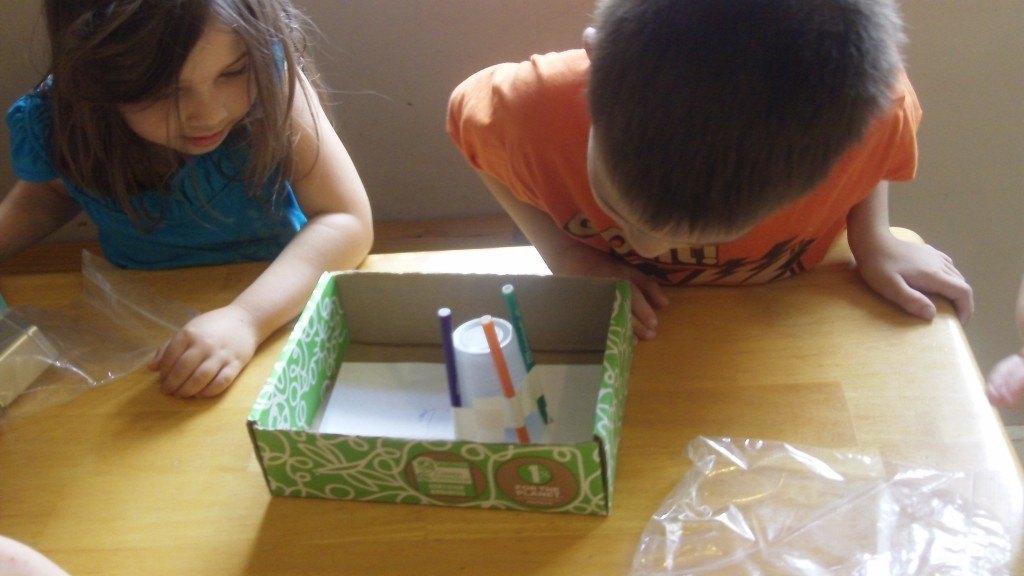
Green Kid Crafts is a subscription program that delivers creative and eco-friendly STEM (science, technology, engineering, mathematics) activities to the doorsteps of children all around the country each month.
Your child could be one of the children enjoying the fun and educational activities from a Green Kid Crafts box!
 My children enjoying their box this month
Each month’s box is packed with 4 to 8 unique and engaging activity kits that are developed by teachers, crafty moms, and STEM experts to support key developmental skills for kids ages 3-10.
Each activity is also kid tested and parent approved for fun.
There is a new theme each month: past themes have included Mad Scientist, Nocturnal Animals, Around the World, Outer Space, and Feathered Friends.

Our theme this month was ROBOTS!
You can purchase subscriptions on a month-to-month, 3, 6 or 12 month duration. Subscription boxes also make great gifts! Subscriptions start at $16.95 / month, and sibling subscriptions are also available. Order at www.greenkidcrafts.com.
COUPON: Use the code take5sp for $5.00 off anything in the Green Kid Crafts store!
ONE WINNER IS GOING TO RECEIVE A ONE MONTH SUBSCRIPTION TO GREEN KID CRAFTS!
Enter using the form below:


Is your husband ever stressed, discouraged, or frazzled? (Of course he is!) Sometimes we wives get so caught up in the burden of our own responsibilities and concerns that we forget our husband also has his own burdens to carry. Can I challenge you to build up your husband through your words and actions? Here are 5 ways to encourage your husband today:
1. I'm praying for you.
Every husband should have the privilege of knowing his wife is laboring in prayer for him as he faces the pressures of the day. But don't stop at praying for him…let him know that you are!
2. Thank you for…
Show gratitude even for the little things.
3. I love it when you…
Don't focus on what you don't like about your husband. Telling him about the things you like will encourage him to do more of it.
4. You do such a great job at…
Husbands love it when their wives pump up their ego a little bit. Just sayin'.
5. I made this/did this/bought this for you.
When's the last time you did something for your husband just because you love him?
What are some other ways you can think of to encourage your husband?
Other posts you might like: